Posts by Paul Ortiz
Depths of Grace
Kindred in Christ,
Letting go can be hard. And yet, for an authentic Christian spirituality, it is essential.
I was once at a church retreat. As I was relaxing and reading a book on a beach chair on the dock of a lake, I was overhearing a conversation between my friend Brian and his then 11-year-old son, Henry. “I want to learn to dive!”, Henry stated with excitement. Apparently, he was a good swimmer and diving was the next step.
My non-anxious parent-friend said, “Sure, son. It’s not too difficult. Just stand at the edge of the dock. Put your hands together while pointing them to the water. Then lean over and just let yourself fall headfirst into the lake. That’s how you dive.”
Henry looked a little puzzled, “Really, that’s how you dive?” So, he puts his little body into position. He waited for the courage to come. And right as he began to let himself go and dive into the lake, he simultaneously tried to pull himself back up at the last second, which resulted in him belly flopping instead of diving. He came up spluttering and gasping, “Dad, it didn’t work!”.
Brian responded, “That’s right son; it’s because you didn’t let yourself fall in. Good try though! Try again. I know it is scary, but this time just let yourself fall in.” Henry tried again and again for half an hour! It just did not happen. Each time he would end up on his face or belly, because he would hold back and not just let himself fall in. Eventually, he gave up and walked back to the cabin.
I was watching all of this with great interest from the corner of my eye while pretending to still read my book, because I personally know how hard it can be to just let go in life and trust God. I think Henry’s story speaks for a lot of us who want to go deeper, beneath the surface of our spirituality or relationships, but find it hard to let go of the superficial things that provide us temporary comfort.
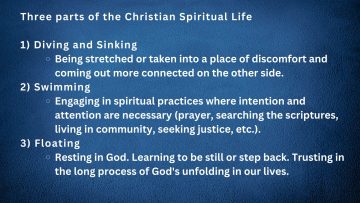
Over the next three weeks we will explore together three aspects essential to the Christian spiritual life, both for us as individuals and as a church:
I look forward to exploring these themes and learning to go deeper together!
Alongside you,
Rev. Paul Ortiz
Pentecost and Pride
Kindred in Christ,
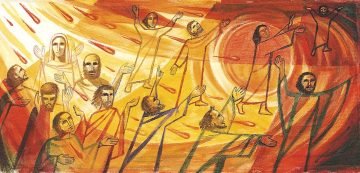
This Sunday we celebrate Pentecost, a.k.a. ‘the birth of the church’! We hear of rushing wind, tongues of fire, and the breaking down of social barriers. The multilingual celebration we read about in Acts 2 reminds us that God sent all humanity a gift—the Spirit, with its promise of passion, diversity, and creativity.
Yet, it is not an exclusive party. With all that wind and noise, and hazardous pyrotechnics of the Spirit, the text tells us that the Apostles were moved outdoors to begin their multi-lingual proclamation. While they began indoors, the Spirit pushes them outdoors to connect with new people in new ways. Rather than starting outdoors and being moved inside a temple, the Church is born when a group is empowered to “come out” and connect with the world in a new way.
This Sunday also kicks off our Pride Month series, God is Proud of You! We will celebrate the LGBTQIA+ community and the way the Spirit is still working to break down walls that exclude and birth new and inclusive community through us.
I hope to see you as we celebrate Pentecost and Pride in the weeks to come through worship gatherings and outreach events.
Alongside you,
Rev. Paul Ortiz
Ascension Sunday
Kindred in Christ,
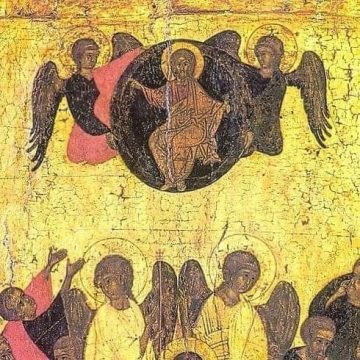
This coming Sunday is Ascension Sunday! And while a major feast day in the church calendar, it is not accompanied by a wealth of traditions like Easter, Christmas, or even Pentecost. There are no Ascension Day cards to give to loved ones, nor any Ascension Day family dinners to attend—at least not in my family. Nor do any familiar Ascension Day hymns come to mind.
Perhaps because at first glance the story of the Ascension seems bizarre and sad—the resurrected Jesus ascends into heaven and abandons the disciples on earth (Acts 1:1-11).
Yet as much as the disciples must have wanted Jesus to just to stay put, in Jesus we do not see a God that stays put. Rather, Jesus reveals a God that transcends our assumptions and expectations, to fill all creation with divine love and bring us to a faith that is as expansive as the sky.
Christ ascends into the depth for us to find Christ everywhere, especially where the world only sees death and despair. As Lutheran theologian Vitor Whesthelle reflects, “It is from down below that he comes. Don’t look into heaven. It is from down below that glory emerges. Don’t gaze up, look down. Look down where life is broken, where creation is tortured, where nature is abused. Down there in the troubles of our days lies the glory as much as it once was found in the womb of a poor peasant maid of Galilee or lying in a manger in the midst of dung, animals, and flies. Consider then the homeless old woman in the city street and know that Christ is there and that NATO’s whole air force in all its glory is not armored as she is. So, do consider the lilies of the field, but consider as well the pollution, the waste, and the violence against which the blossoming of the most simple flower is already a triumph that beats the odds and tells a story of ascension.
May the glory down below shine through our lives in its unseemly fashion so that we might know that what God assumes God redeems and then we will also know that we don’t need to be anxious about tomorrow, for we know the places where tomorrow begins.”
Alongside you,
Rev. Paul Ortiz
We are Resurrected!
Kindred in Christ,
I am excited to celebrate the resurrection of Christ with you this Sunday! I hope you are each inviting your friends and family for this joyous occasion and special services (9 AM and 10:30 AM). Not only are we celebrating God’s power of life over systems of death, but we are also marking a year since we relaunched with our new identity as a church community. It was last Easter when we began gathering in an unconventional space for in-person worship, and changed our name to University Gathering UMC!
Since then we have resurrected the Children’s ministry, which is now thriving and ministering to 5-7 kids every Sunday. We have done new forms of outreach and have created community through small groups, service projects, and other forms of connection. We have had 9 new members officially join the church and we continue to make new relationships and get new visitors. And this Good Friday and Easter we will resurrect the choir!
I give thanks to God for all these things and more, which we have done together since last Easter. During this season we commemorate God’s power of rolling away immovable stones, and making new life possible. I look forward to continuing to walk with you in these new possibilities, and seeing what new stones God will roll away this coming season!
Alongside you,
Rev. Paul Ortiz
The Political Parody of Palm Sunday
Kindred in Christ,
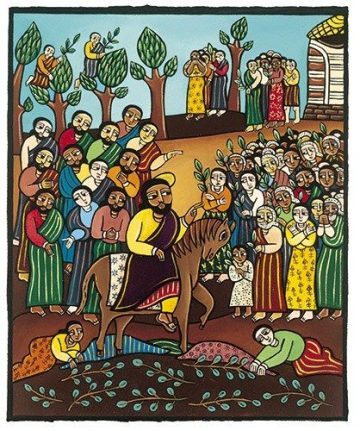
As we enter into Holy Week, we are reminded that with Jesus things are never as we would anticipate, and that to be open to God requires us to be open to the unexpected. Regarding Palm Sunday and Jesus’ entry into Jerusalem, author and activist, Shane Claiborne writes, “As Jesus rode a donkey into Passover, it was a lampoon of power, political parody at its best. Kings didn’t ride donkeys. They rode war horses with an entourage of soldiers. It would have been like the president riding a unicycle to their inauguration.”
I hope you will join us for Palm Sunday, Good Friday, and Easter Sunday, as we attempt to follow the one who rides into our world through vulnerability and love and calls us to follow in his way.
Alongside you,
Rev. Paul Ortiz