News
Road Blocks
Kindred in Christ,
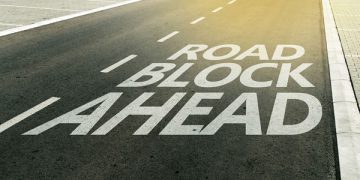
Author Ruth Haley Barton describes discernment as an ever-increasing capacity to “see” the work of God in the midst of the human situation, so that we can align ourselves with whatever God is doing in our present. Yet if you are like me, sometimes you feel like you have already figured out what God wants you to do and already have a set plan in motion, and you forget about the need for ever-increasing discernment. And when roadblocks come up in our lives that cause our trajectories to feel “stuck” we get frustrated. The temptation in these situations is to either plow forward at all costs or give up and turn around. But what if the roadblocks in our lives were holy reminders to pause and reflect deeper? What if each time we felt stuck in a situation with our job, family, or community life, we utilized those spaces as a reminder that we do not always know exactly where God is leading and there is always a need for deeper discernment?
This week we will reflect on the story of Balaam (Numbers 22:21-35). A famous “seer” of the ancient world, yet, ironically, was unable to see that the Angel of the Lord was blocking his path. Balaam was so sure that he understood his mission that it took him awhile to be able to listen to his recalcitrant donkey and the roadblocks along the way. But through pausing, he eventually learned that God had greater plans for his life.
Join us as we continue in our series, Lessons from the Wilderness. I hope to see you on Facebook Live!
Alongside you,
– Rev. Paul Ortiz
The Form and What Gives it Form

Kindred in Christ,
The artist Scott Erickson (whose work involves liturgy and faith) recently posted the art piece above on his Instagram account with the caption, “If you love the form, you have everything to lose. If you love WHAT gives it form, you’re free to receive whatever it is turning into.” The depiction of a church building crumbling in an hourglass is a provocative metaphor of the effects of an evolving culture upon stagnant religious structures and formulas. Seemingly tried and true ways of doing church will die over time as society shifts, but what gave these structures life in the first place will continue to give life to new ways of gathering, worshiping, and following Jesus that are relevant in the present moment—the image suggests.
Yet for us, Erickson’s image hits in a literal sense as well. Our physical building will soon begin to be demolished, and we will await the construction of something new. While it is appropriate to grieve what we are losing (and we will gather for a viewing of the demolition in June, stay tuned for more details), this season provides us a unique opportunity to ask, “WHAT is beneath the form of our religion?” “WHAT is the thing that gave it life in the first place and that will give life to something new?” If we can tap into that, then (as Erickson suggests) “you’re free to receive whatever it is turning into.” This is one of the great gifts of the wilderness—the invitation to strip things down and reflect what is at the heart of our faith, and our being.
I look forward to continuing to journey the wilderness with you and hope to see you this Sunday on Facebook Live as we continue in our series, Lessons from the Wilderness!
Alongside you,
– Rev. Paul Ortiz
Lessons from the Wilderness
Kindred in Christ,
After taking a couple weeks off to enjoy time with family and our new corgi puppy, Tato, I am excited to be back with you! I am also excited to begin our new worship series, Lessons from the Wilderness. As people we often find ourselves in “wilderness” spaces throughout our lives. This usually looks like when we have lost a grounding (such as a job, relationship, church building, routine etc.) and before we have replaced it with another one. These transitional spaces can be scary at first, but they are also sacred and often bring us into new realities with God. Brené Brown writes in her book, Braving the Wilderness, “The wilderness is an untamed, unpredictable place of solitude and searching. It is a place as dangerous as it is breathtaking, a place as sought after as it is feared. But it turns out to be the place of true belonging, and it’s the bravest and most sacred place you will ever stand.”
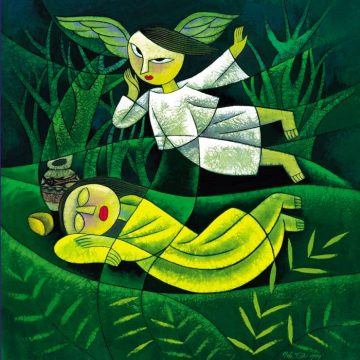
Throughout the biblical witness, we see that God shows up in the wilderness and that God’s people often learn special lessons that could only be found in these uncharted spaces. This week we will kick off our series by reflecting on the story of Elijah, and a time that he found himself in the wilderness (both literally and figuratively). As a mighty prophet, Elijah was used to success in ministry and life. However, in the passage this week (1 Kings 19:1-18) he finds himself alone and has given up. Yet as reflected in the He Qi’s painting above, Elijah eventually learns the spiritual practice of receiving well. As he receives the gift of bread and water in the middle of the wilderness, he learns that what was true all along—everything we have is a gift from the earth, from our communities, and from God. He also learns that he is part of a much bigger story, one not limited to his own strengths and vision. This is a hard spiritual lesson, but an essential and liberating one for our lives of faith.
Join us as we reflect deeper on what it means to be a people that know how to receive well as we journey the wilderness together as a community. I hope to see you on Facebook Live!
– Rev. Paul Ortiz
Were You There?
Kindred in Christ,
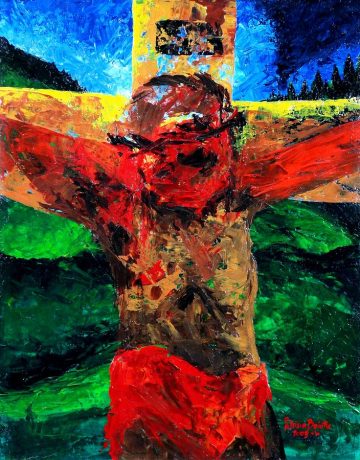
As we reflect on God’s solidarity with our experiences of human pain and oppression this Good Friday, I want to offer you some reimagined lyrics to the old hymn, “Where You There When They Crucified My Lord?”
Were you there when they crucified my Lord?
Were you there when justice was ignored?
Oh, the thought makes me tremble…
Were you there when they crucified my Lord?
Were you there that day on Calvary?
Were you there when he whispered, “I can’t breathe.”
Oh, it causes me to tremble…
Were you there when they nailed him to the tree?
Were you there when the cops shot him in the street?
Oh, it causes me to tremble…
Were you there when they pierced him on his side?
Were you there when the AAPI community cried?
Oh, it causes me to tremble…
Were you there when the spa became a tomb?
Oh, it causes me to tremble, tremble, tremble…
– Rev. Paul Ortiz
Expectations and Surprise
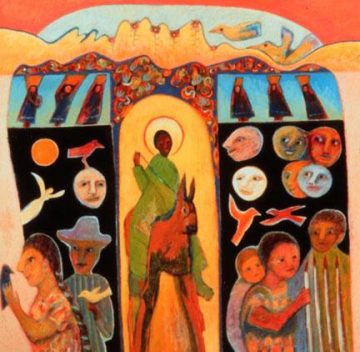
Art from Guatemala
Kindred in Christ,
Have you ever been so sure that you knew what was going to happen, that when it did happen, you almost missed it entirely because things didn’t go the way you had imagined?
Like when my daughter was so sure that her flu shot was going to hurt that she cried and wailed until we told her, “Hey, it’s already over!” And then she composed herself and said, “Oh, I didn’t even feel it.”
Or like the time I proposed to my now spouse, Kim, during the month of October with a bunch of carved pumpkins spelling out “will you marry me?”. And her first response was, “Wait? What? Now? Here?!” Thankfully, she eventually said “yes.”
As we enter into Holy Week, we are reminded that with Jesus things are never as we would anticipate, and that to be open to God requires us to be open to the unexpected. Regarding Palm Sunday and Jesus’ entry into Jerusalem, author and activist, Shane Claiborne writes, “As Jesus rode a donkey into Passover, it was a lampoon of power, political parody at its best. Kings didn’t ride donkeys. They rode war horses with an entourage of soldiers. It would have been like the president riding a unicycle to their inauguration.”
Join us this Sunday as we celebrate Palm Sunday and explore what it means to put our expectations aside in order for them not to get in the way of the new thing God is doing in our present. See you on Facebook Live!
Alongside you,
-Rev. Paul Ortiz