Homecoming Sunday 2025

Kindred in Christ,
Have you ever stumbled on something so beautiful, so unexpected, that it changed everything? That’s how Jesus describes the kin-dom of heaven in Matthew 13:44–46—a hidden treasure, a pearl worth giving everything for. On Homecoming Sunday, September 21 at 10:30am, we’ll gather to celebrate that kind of joy: the joy of being found, claimed, and treasured by God. And I can’t wait to celebrate with you!
Psalm 113 reminds us that the Lord is above all nations—not captive to any one flag or power—and yet stoops down to lift up the poor and the lowly. That’s the opposite of Christian nationalism, which twists faith into a tool for domination. Instead, God’s kingdom is a community where grace is the center and where all are lifted up.
Homecoming is our chance to celebrate that vision together: to remember that we belong, to rejoice in the love that binds us, and to invite others into the joy of community. After worship, we’ll share a potluck meal and explore a Memory Lane photo wall—celebrating our congregations’ histories, adding your significant dates from the past, and beginning new stories together.
This is a Sunday to come home, to bring a friend, and to discover again that God’s treasure is here among us in community. Don’t miss it!
Alongside you,
Pastor Paul Ortiz
Costly Belief

Kindred in Christ,
When my child was about two years old, they had a favorite new phrase: “I believe in you.” For months, it was everywhere. They said it to baristas, neighbors, dog walkers—anyone who crossed their path. It was their way of trusting, connecting, and sprinkling a little love into the world. The phrase carried a weight far beyond their years.
One night, I was exhausted—balancing seminary, work, parenting, and life—and I sighed at the kitchen table, staring at my computer. My child looked at me, placed their little hand on my arm, and said: “I believe in you.”
In that moment, the phrase landed differently. It wasn’t just a catchphrase or something repeated without thought. It was a lifeline—a deep and tender reminder that belief is never abstract. Belief is lived, relational, and powerful.
This Sunday, we continue our series Costly Grace: Following Jesus in the Face of Empire. We’ll explore what it means to believe in Jesus through a sermon titled Costly Belief, based on 1 Corinthians 1:18–24 and John 3:13–17. These passages invite us to see faith not as a set of doctrines or rules, but as trust and relationship—something that asks something of us.
True belief in Jesus is costly because it moves us beyond comfort, beyond self-interest, and into a life of solidarity, care, and hope. It’s the kind of belief that transforms communities, challenges empires, and turns the logic of the world upside down. It’s the kind of belief that says mercy is stronger than vengeance, love is stronger than fear, and care for the outcast is more faithful than seeking status or dominance.
Just as my child’s words reminded me of what really matters, our faith can transform the world when we live it in this way. Believing in God is inseparable from believing in one another—in those whom the world forgets or dismisses, and in the possibilities of love over hate.
Come ready to be believed in—and to believe in others.
Alongside you,
Pastor Paul Ortiz
Homecoming Sunday & Memory Lane Project

Homecoming Sunday – September 21st
As summer winds down and we return to familiar rhythms, we invite you to join us for Homecoming Sunday! Bring friends and family for a joyful day featuring welcoming new members, special music, an interactive “memory lane” celebrating the histories of our congregations, and a potluck following worship. Also, our new District Superintendent, Rev. Elizabeth Ingram Schindler will be joining us for the service and helping lead worship.
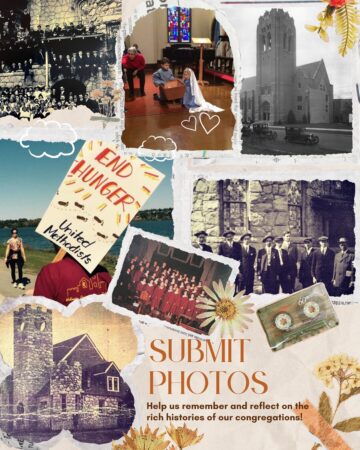
Send Photos for the Interactive Memory Lane
As part of Homecoming Sunday, we’re creating an interactive timeline collage celebrating the histories of Green Lake UMC and U Gathering/Temple UMC. We invite you to submit photos from the past 100 years to office@ugathering.org by September 18th to be included. Alongside the photos, there will be space for you to add significant events and memories. Together, we’ll reflect on our rich histories as we look with hope toward the future!
Costly Grace
Kindred in Christ,
When nationalism hijacks faith, the Gospel calls us somewhere deeper—into Costly Grace. This September we begin a new worship series by that name, where we’ll confront shallow religion and the lure of easy answers, and instead follow Jesus into love that disrupts, heals, and transforms.
We’ll draw on the witness of Dietrich Bonhoeffer, who resisted Hitler’s regime, and James Cone, who proclaimed the cross as God’s solidarity with the oppressed. Their voices remind us what’s at stake when grace is costly. Bonhoeffer once wrote, “grace is free, but it will cost you your life.” Real grace—the kind that transforms us—calls us deeper. It asks us to let go of what gives us false security and to trust the abundant life God offers.
This week’s message, “The Call into the Deep” (Luke 14:25–33; Psalm 1), will invite us to move beyond surface-level faith. Jesus’ shocking words about family, life, and the cross remind us that discipleship means diving into waters deeper than wealth, patriarchy, nation, or status. Together, we follow Jesus—who calls us into the deep.
We will also share in a Back-to-School Blessing during worship. We’ll pray for students, teachers, administrators, and all connected to schools as a new year begins. Bring your backpacks, your energy, and your hopes for the year ahead—we want to bless you as a community of faith!
Come ready to be stretched, encouraged, and blessed as we begin this new season together.
Alongside you,
Pastor Paul Ortiz
Practicing Hospitality
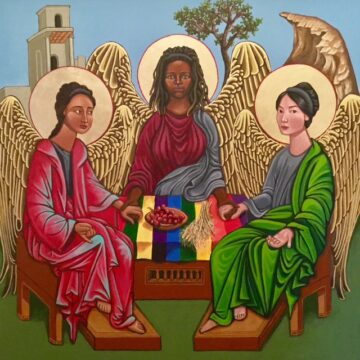
Trinity by Kelly Latimore
Kindred in Christ,
Every ending carries within it the seeds of a beginning. As we come to the close of our Interwoven by Grace series this Sunday, we are reminded that God is always weaving something new among us — in our congregation, in our community, and in each of our lives.
This week’s scriptures invite us into that newness through the practice of hospitality. Hebrews calls us to “let mutual love continue,” to show kindness to strangers, to remember those in prison, and to offer our lives as a sacrifice of praise. In Luke’s Gospel, Jesus challenges the culture of status and self-advancement by telling his followers to choose the lowest seat and to invite the poor, the needy, and the blind to the banquet.
Hebrews even goes so far as to remind us that in welcoming the stranger, “some have entertained angels without knowing it.” That is the gift and the mystery of inclusion: when we open our lives to those who are different from us, we also open ourselves to God’s surprising presence. Hospitality is never a one-way street. It reshapes us, expands our vision, and makes room for the Spirit’s discernment anew. The stranger who comes among us may be the very messenger God is sending to lead us into deeper faith and new growth.
Making room at the table is not only an act of justice for those who have been marginalized or excluded — it is also the way God changes and grows those of us who find ourselves at the center of power or society at any given time. It opens our eyes to new perspectives, sharpens our ability to discern God’s voice, and reminds us that grace is always bigger than the boundaries we draw.
As we wrap up this season of worship, we will reflect together on how humility and hospitality become acts of faith — and how God continues to shape us into a community where strangers become friends and love takes root in action. Like Rublev’s ancient icon reimagined in Kelly Latimore’s Trinity (above), we are invited to see ourselves at a table where every face reflects God’s image, and where the colors of creation hint at a feast without end.
I hope you’ll join us this Sunday as we give thanks for all God has been doing among us, and as we look ahead with expectant hearts to what comes next. Your presence is part of the story God is writing here.
Alongside you,
Pastor Paul Ortiz