News
Healed to See One Another
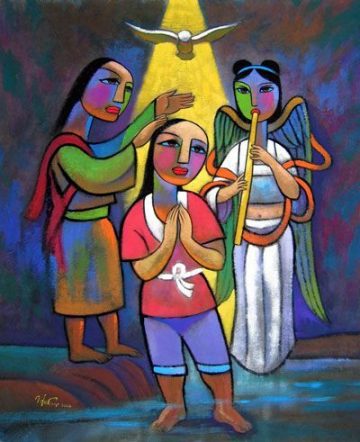
Jesus’ Baptism by He Qi
Kindred in Christ,
This week we were reminded that white supremacy, patriarchy, and purity culture kill and destroy and cause so much pain in our world, especially to our Asian, Asian American, and Pacific Islander siblings.
This week we were reminded that young white men are being shaped by the false discipleship of racism and sexism inside churches that worship gun and country over Jesus.
This week I grieved deeply with my Asian family members and friends. And I was personally reminded of the great need to commit to learning from AAPI histories, leadership, and creativity, and to practice imperfectly, but with consistency, solidarity with all those who seek an end to the powers and principalities that create the conditions of the violence we witnessed in Atlanta.
This week I meditated on the story of Jesus’ baptism, and the fact that in those waters he heard a voice telling him he was fully seen and beloved by God. Even in the face of evil systemic forces, such as white supremacy, that try to erase our AAPI siblings, God sees each of us fully, and empowers us all to see one another fully, and to work toward ending anti-Asian racism.
May we continue to grieve and lift up our pain to a God who draws near to the brokenhearted and speaks liberation to our weariness and grants us eyes to see one another more fully.
Alongside you,
– Rev. Paul Ortiz
Our Crosses

Kindred in Christ,
Have you ever gone to therapy or a support group to help you work through grief or pain in your life? As healing has these spaces have been for me, they often cause me to look at (or pick up) unpleasant aspects of my life that I would like to otherwise ignore. Yet the reality is that to completely ignoring my pain and grief is not healthy. And it is quite healing to eventually bring these aspects of my experience to the light and receive guidance regarding what to do with my human pain.
It is likely that you have, at one point or another, heard of Jesus’ famous call to “pick up your cross and follow me” (Matthew 16:21-28). Unfortunately, this saying has been misused by some throughout history to justify human oppression and abuse. This interpretation suggests that when we see people in pain, “well, it is just their cross to bear”—as if Jesus was handing out suffering to people. Tragically, this interpretation not only leads to complacency in the midst of injustice, but it completely misses the radical call of Jesus’ invitation into discipleship.
Jon Sobrino, as well as other liberation theologians, suggest that “Jesus is not handing out crosses as a price to follow him,” rather, “Jesus is shows us what to do with the crosses [human suffering] that we already have.” Thus, Jesus joins us in our struggle, invites us to walk alongside him and others in solidarity, and guides us all. It is also important to ask, where is Jesus leading us towards as we follow him? It is not towards more crosses (for we already have those in our broken world), but it is toward liberation and resurrection!
Lent, in many ways, is like a support group with God and community. Lent invites us to pick up those painful aspects of our human existence that we would otherwise ignore. Lent also offers us needed guidance with what to do with the human pain, which would eat away at us if we had not brought them to the light. If we allow ourselves to be open to Jesus, we can carry our burdens in the context of community toward collective healing and restoration. Join us this Sunday as we reflect on this and more by continuing in our Lenten worship series, The Path Back to You. I hope to see you on FB Live!
Alongside you,
– Rev. Paul Ortiz
Our New Logo

Kindred in Christ,
After having many meaningful conversations about our new logo and creative branding, I want to post about the meaning behind the new image here:
Our new logo came out of deep reflection upon our current community, as well as who we are called to become. The crisp and colorful shards intentionally resemble stained glass windows common in sanctuaries and other contemplative spaces. The array of colors encompass the totality of the liturgical calendar. And the variety of shapes, sizes, and colors of each of the pieces that comprise the whole represent the diverse community we will become. This is all held within a triadic-flame, which is a symbol for the triune God. It is a dynamic image, one that is intended to evoke holy passion and creativity.
May we live into all that our new logo represents and more!
Alongside you,
– Rev. Paul Ortiz
Prodigal God
Kindred in Christ,
During this Lenten season, we have reflected much upon prayer labyrinths and the winding paths of our human lives. Lent, in many ways, is designed to remind us that we are vulnerable to the twists and turns of life. And that this is just part of what it means to be human and to be in need of God and one another. There is an existential freedom that can be experienced once we accept that we are not overtly in control of our lives, but that we can only do our best and move forward in trust (or faith). This also leaves room for God to surprise us on the road and embrace us in unexpected ways.
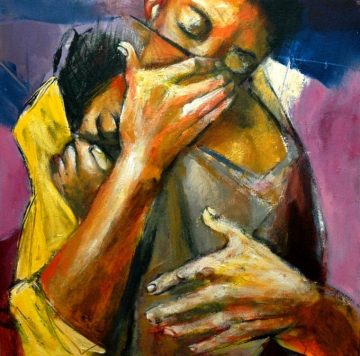
As we will reflect upon this Sunday, Jesus told a story of two sons, one who squandered his inheritance and the other who lived a life of mirthless duty; neither lived in the freedom of their loving parent (Luke 15:1-2, 11-32). Yet their loving parent journeys out toward them, each on different occasions, to embrace them and remind them who they are and the love that is always theirs, no matter what.
Each of the sons was invited to give up the goods that they had (freedom or duty) in order to go deeper into something even better (the unconditional love of their parent). For many Christians throughout the centuries, giving up something (or a fast) has been central to the observance of Lent. We give up something good in order to receive something better. Though we most often relate this to physical fasting, giving up meat, sugar, eggs, and other rich foods, our fast can be anything. This is not meant to be an act of abjection—these are not ills we’re giving up—but rather an act of love and devotion.
It can be helpful to think intentionally about this as a rhythm of both fasting and feasting—of setting aside and taking up—and choose something specific to feast on in exchange for our fast. Fasting has much to teach us about our dependencies and our needs. If you have yet to give anything up and/or take up anything for Lent, I invite you to prayerfully consider it. It’s not too late!
Whatever way you decide to practice Lent, my prayer is that you will discover the surprise embrace of our loving parent in the midst of our human journeys. Join us this Sunday as we continue to reflect on the meaning of Lent with our series, The Path back To You. I hope to see you on Facebook Live!
Alongside you,
– Rev. Paul Ortiz
The Cross and the Lynching Tree

Kindred in Christ,
Have you ever felt utterly abandoned or forsaken—maybe even by God? Perhaps it was a time you found yourself alone in the hospital facing uncertainty of health. Perhaps it was after the untimely end of a friendship or marriage. Perhaps it was during an economic hardship that you never imagined you’d have to face. Whatever the case, the twists and turns of our human journeys can sometimes leave us feeling defeated and alone.
In the opening of The Cross and The Lynching Tree, the founder of Black Liberation Theology, James Cone, insists to us, “The cross is a paradoxical religious symbol because it inverts the world’s value system with the news that hopes come by way of defeat, that suffering and death do not have the last word, that the last shall be first and the first last (Pg. 2).” As we journey toward the cross this Lenten season, we are all invited to contemplate our own human experiences of defeat, suffering, and even death. Rather than pretending that these pervasive parts of our lives do not exist, we can meditate upon them and find that God is with us in solidarity though as the Crucified One. Lent has the power to invert our understanding of human vulnerability as the site where we can encounter God. Indeed, the gospels reveal that God enters our world to share in human suffering and oppression, in order to inject healing, salvation, and liberation into our lives.
As we will see on Sunday, Jesus did not shy away from reflecting upon human tragedy and untimely death (Luke 13:1-9). He even went as far as to raise the question if the victims of calamity were being punished by God for their sins (which was the stigma of the day). Jesus answers this hypothetical question with an unequivocal “no”. We are not being forsaken by a punishing God in our experiences of human suffering. This is a false theology that denies God’s nature of solidarity and love. As we will reflect further on Sunday, Jesus offers us an image of a God who is with us through the totality of human life (the joys and the pains) always nurturing us toward resurrection. This is good news in a world of twists and turns! Join us as we continue in our worship series, The Path Back to You. See you on FB Live!
– Rev. Paul Ortiz