News
Counting Stars

Have you ever tried to count the stars?
Even if you have never literally attempted to count them all, I know that many in our church community enjoy observing the constellations and marveling at their expansiveness. Stars have a way of reminding us that while we are significant to God, we are but a small part of a much bigger story.
While at first this may be a bit of a hit to our personal egos (the reminder that I am not the center of the universe), it also has the capacity to bring pure spiritual joy. Looking up at the magnitude of the heavens reminds me that God notices me even in the mist of such an expansive creation, and it also reminds me that God also notices countless others who have also stared up at the stars. God’s story of redeeming love is both about me and more than just me. And when I lean into that seemingly paradoxical reality, my soul, faith and dreams expand.
This week, we will kick of our new worship series, which coincides with our pledge campaign, titled Dream Big! And we will begin by reflecting upon God asking Abram to count the stars in the night sky (Genesis 15). I hope you will join us!
Rev. Paul Ortiz
The Great Cloud of Witnesses
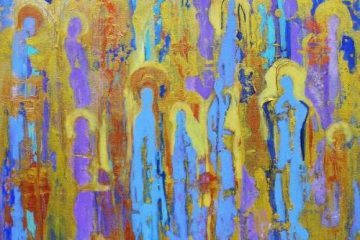
Communion of Saints, artist unknown
Autumn has always been my favorite time of year. Since childhood I have loved to witness the changing of the seasons, the turning of the leaves, and the beginning of the holidays. As I grew older, I also came to deeply appreciate the sacred beauty of the dying leaves and the hope that the trees will later bloom again with new life.
I am particularly appreciative for this upcoming autumn week that holds some festive days. All Saints or All Souls, which we will honor this Sunday, is a day when we are invited to remember the “great cloud of witnesses” (Hebrews 12:1) that have gone before us, yet in some mysterious way still bless and journey with us. Afterwards, Día de los Muertos takes place on November 1st and 2nd, a Mexican holiday that is often described as a “fiesta where all the dead relatives come to party with you.” Among all these traditions, there is the insistence that the veil between the living and the dead is a little thinner during this time of year.
As you continue to move though this season, I invite you to consider who lingers close to your memory? Who walked with you in such a way that challenged, inspired, and shaped the path that you travel today? Remembering that in these days, the veil thins not only towards the past but also towards the future; how are you moving through this life in a way that will help make possible the paths of those who follow?
We will reflect further on our connections to all the souls and saints forever held with us in God’s love, as we conclude our sermon series, Re-connect. See you on Facebook Live!
Rev. Paul Ortiz
Meaningful Connections
Kindred in Christ,
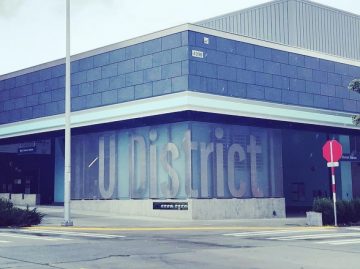
This past week our neighborhood celebrated the opening of the new University District light rail station (pictured above). This marked a major milestone for transit in Seattle with three new stations in total—University District, Roosevelt, and Northgate. Since I began serving as your lead pastor, two emerging structural realities have always been on my mind and in my prayers, the opening of this new station and the redevelopment of our church building/community hub—each about a block away from the other. Thus, this past week felt like a major milestone for me personally, as well.
I imagine that in many ways, the Seattle community developers dreamed and struggled similar to some of the ways we have as a congregation. I imagine they too had to take risks and encounter setbacks. My continued prayer is that our new building will also serve as a concrete reality that helps our larger community be more connected.
This morning I was able to connect over coffee with a young woman that I initially met at an art making outreach booth we hosted on the day the new station opened. Among other things, she mentioned taking the train to our meet up and how she was interested in being part of a new small group that our Children and Families’ Minister, Gina Pacheco and myself will be starting in November. In our conversations, I was reminded of the many ways that our city not only desires connection but also is actively evolving and working to be more connected. I am grateful that we as a church get to be part of this growth with the future emergence of our physical building, and with the various ministries we are doing in the present.
My hope is that you too will experience meaningful connections in your life and celebrate the milestones that move you closer to God, neighbor, and your true selves. And I hope you will connect with us in real-time this Sunday for virtual worship; as we continue in our series, Re-connect! See you in the comments!
Alongside you,
Rev. Paul Ortiz
Re-connect
Kindred in Christ,
I was very much looking forward to switching over to broadcasting/streaming live our worship services starting this Sunday, 9/12. I was anticipating connecting with each of you in this new way, and beginning our new worship series, Re-connect! Yet, despite best efforts from our hardworking tech team and worship team, we will not be able to do so until the following Sunday, 9/19. Ironically, we are experiencing some internet connectivity issues as we attempt to launch a series on connection—which has been all too common during this time of pandemic.
Since at this point it is also too late to put together an alternative, prerecorded service, we will instead be connecting in a very different way this Sunday, 9/12. Please find the Zoom link for Sunday morning worship gathering below, and click on it for a time of spiritual reflection and discussion. Also, I invite you to have some bread-like substance and coffee or juice ready, so we can commune and connect in the way of Jesus across space and screens in real time! Zoom Meeting: https://greaternw.zoom.us/j/99933282457
Here are the prompts for Sunday’s Zoom gathering:
What does connection mean to you?
When have you felt disconnection?
When have you been surprised by connection?
What might it mean to think of God as connection itself?
I pray that each of you are experiencing deep connection during this time of continued social separation. And I hope to see you in real time, this Sunday!
Alongside you,
Rev. Paul Ortiz
Blessed are the Queer
Kindred in Christ,
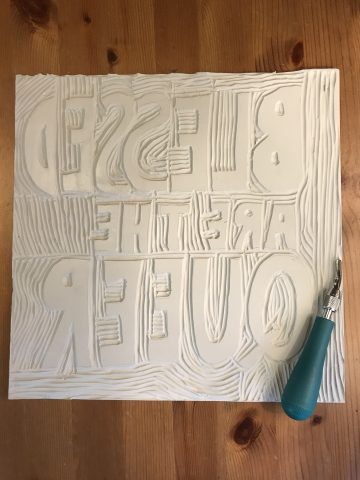
The above graphic is a picture of the linoleum stamp my partner Kim carved for our Printmaking Pop-up booth tomorrow at PrideFest Capitol Hill. Volunteers from both inside and outside our congregation will come together to invite people from the festival to create art, celebrate LGBTQIA+ Pride, and have fun!
As you might make out, the linoleum block above has been carved with reversed letters stating, “Blessed are the queer.” Stamps must be carved in reverse, so they print the image correctly. Yet, when I first glimpsed the stamp Kim had created, I was deeply reminded of the reverse nature of Jesus’ image of the kin-dom of God. “Blessed are the poor (Luke 6:20),” Jesus proclaimed in the face of a world that understood the wealthy and powerful as blessed and saw the poor and sick as cursed.
For a long time, the term “queer” was strictly used as a slur or curse word toward the LGBTQIA+ community. Indeed, I have been called this term when I was bullied in high school. And sadly, it is still used today in this despairing way by some. However, the term has also been reclaimed or reversed in recent years, as a statement of Pride by the very community it was intended to harm. Subverting and reversing ignorance, bigotry, hatred, and fear is what the kin-dom of God looks like in our midst. The reclaiming of the word queer always makes me think of the reversal nature of the kin-dom of God and the many ways it is all around us.
I hope that you will consider stopping by our booth (more info below) and perhaps catching a glimpse of God’s counter cultural kingdom. In the meantime, I share with you what Jesus’ blessings might sound like in our day:
Blessed are you who are queer, for yours is the kingdom of heaven!
Blessed are you who are undocumented, for papers and borders are not real and will not dictate your lives!
Blessed are you who are Black, for you are beautiful, powerful, and in the kingdom of God your lives will matter to the system, as well as to one another!
Blessed are you who feel crushingly alone during this lockdown, for God’s company has come near to you!
Blessed are you who are seasonally depressed, for the sun will shine upon your sorrow!
Blessed are you who are indebted—to the hospitals, to the schools, to the credit card companies—for there is more than enough to forgive your debts!
Blessed are you who are poor, for God is with you and Jesus has joined you in poverty.
Blessed are you.
Alongside you,
Rev. Paul Ortiz